
Duke is the epitome of work-hard, play-hard culture. Aside from all the top-tier academics and research opportunities, Duke wants students who will seamlessly fit into their culture and vibe. They want academically inclined students, of course, but they also want leaders, collaborators, creators, researchers, athletes, artists, and students who seem genuinely excited to get involved in everything Duke has to offer.
That means getting into Duke requires more than just strong numbers – you need to be a personality fit, too! So what actually makes a Duke hopeful stand out? Let's take a dive into the data.
Who Actually Gets Into Duke?
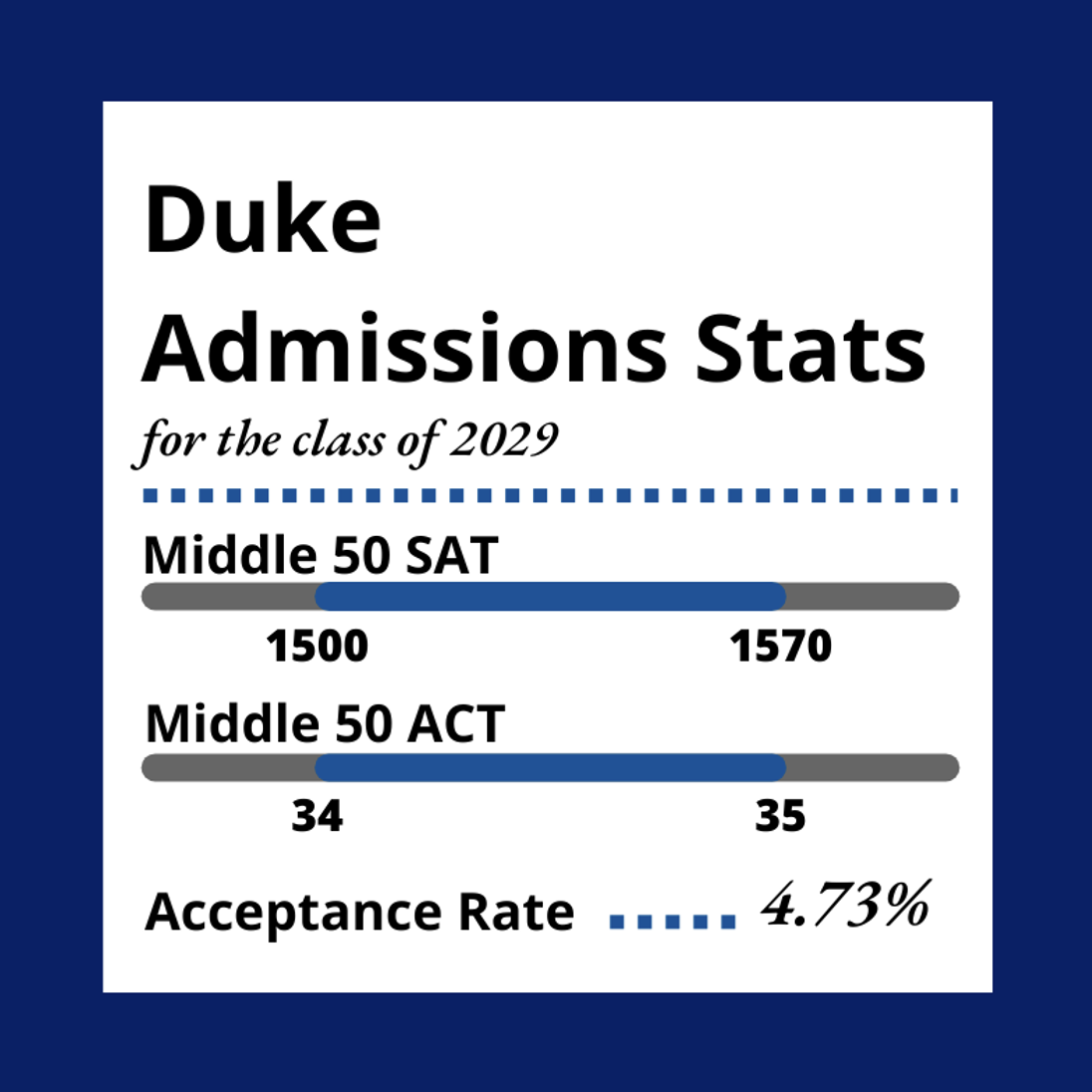
One of the most frustrating things about Duke admissions is that there isn't a clear line separating students who get admitted from students who don't. This is partially because Duke does not participate in the Common Data Set Initiative, which pushes for data transparency in higher education. While the CDS covers a ton of different aspects of the higher ed world, Section C deals with first-time, first-year admissions data, and if we had access to that, we could show you the data that backs up the first-hand knowledge we have about Duke.
Unfortunately, we do not have that data – only what Duke allows us to glean from their website.
Because Duke is choosy with what they release, we’d take some of this data with a grain of salt. A middle 50 of 1500-1570 is a wide spread, but we always recommend being at the highest end of these numbers. And with a middle 50 of 34 to 35 on the ACT, you can bet they expect excellence.
Duke receives applications from thousands of students who have done everything right, on paper, every single year. They took rigorous classes, earned excellent grades, and scored extremely well on standardized tests, and still get rejected. Academics are just the first bar to clear.
What often distinguishes successful applicants is a clear identity, motivation, and story. Their application communicates something specific about who they are, how they spend their time, and what they’re passionate about. These are students doing things like advanced research, deep public service involvement, building their own businesses, conducting in-depth independent projects, or pursuing other passions at a high level.
TL;DR: Duke wants students who have demonstrated excellence, but they also want students who have direction.
What Does Duke Really Want to See?
Let's start with a misconception – most students think Duke wants to see a very well-rounded resume with equal parts leadership, sports, academics, and volunteer work. BZZZT. Wrong. Our clients who get into Duke have an academic niche that they’ve spent years exploring.
Duke wants to know what happens when a student becomes interested in something. Do they simply participate? Or do they take that interest somewhere meaningful?
Duke’s Five Primary Factors:
The rigor of a candidate’s academic program
Academic performance as measured by grades in academic courses
Letters of recommendation from two teachers and a counselor
Extracurricular activities
The quality of thought and expression in the application essay
Let’s do our favorite thought experiment: imagine two applicants with 4.0s and 1600 SAT scores, both interested in environmental science.
The first student joins Environmental Club, volunteers occasionally at local clean-up events, attends one or two summer programs geared towards the environment, plays varsity sports, and serves as vice president of the student body.
The second student is also in Environmental Club, and volunteers at clean-up events, but through those experiences becomes fascinated by coastal erosion after seeing its impact on their local community. They then conducted independent research on erosion, did environmental advocacy work at the city and state level, collaborated with local organizations like the River Keepers, and eventually created a group that teaches elementary school students about conservation.
Student 2 seems a lot more dedicated to their path, and has done the work to prove it. Duke consistently rewards students who move beyond participation and into ownership. They want students who actively create opportunities rather than simply showing up for them.
How Does Duke Decide Who Gets in?
Some students feel like admissions decisions are random, but we promise they're not. In some ways, it’s simple – like when Duke looks at your grades and scores. But as we saw in the last section, it gets much more complicated after that.
Duke admissions officers are evaluating multiple factors simultaneously. Academic performance matters. So do extracurriculars, essays, recommendations, personal qualities, intellectual interests, and the context in which a student achieved what they achieved. No single factor determines the outcome.
Instead, admissions officers are trying to understand the overall picture. They want to know how a student spends their time, what they care about, how they interact with others, and whether they seem likely to thrive within Duke's particular culture.
Your context becomes especially important here. A student attending a small rural public school may have had access to very different opportunities than a student attending an elite preparatory academy. Duke understands this. Applicants are evaluated within the environment available to them, not against some universal checklist. Duke also values public and charter school students at a higher rate – with 58% of the class of 2027 coming from public and charter schools.
They’re trying to build a cohesive class rather than just admitting the highest-achieving applicants. If everyone there was just a perfect-grade, perfect-score, no-other-focus kid, Duke wouldn’t be Duke. There isn't a single "Duke type,� but successful applicants share a few traits: they seem like people who make things happen, and they like being involved at every level.
How Can I Get into Duke?
A lot of students approach Duke admissions backwards: they start by asking what Duke wants and then attempt to build themselves into that person. That strategy almost always produces applications that feel artificial. We know it’s corny to say “Be YoUrSeLf,� and all, but that’s kinda what you gotta do.
Duke applications are strongest when they show genuine enthusiasm for your stated interest area. Admissions officers want to see evidence that students actively pursued opportunities because they cared about them, not because they thought they would impress a college admissions office.
If you're interested in healthcare, show us how that interest evolved and how your focus went from being a doctor in a broad sense to becoming fascinated with pathology. If you're passionate about journalism, demonstrate how you've explored it and talk about how you started the school paper. If you're fascinated by politics, engineering, education, economics, climate science, or entrepreneurship, let your application reflect that curiosity through action!
The essays are where all of this comes together. Duke's supplemental questions give students an opportunity to reveal personality, values, motivations, and intellectual interests. Unfortunately, this is where many applicants begin sounding like miniature corporate executives. Everything becomes polished, strategic, and painfully devoid of actual personality, and please don't do that. As you’ve hopefully learned, Duke likes personality. So put the ChatGPT and Claude down and write from the heart.
Duke is looking for students who are actually excited about contributing to a vibrant community, not students who are simply chasing a prestigious name. And like most highly selective university hopefuls, successful Duke applicants usually develop over time. Their applications reflect years of exploration, academic rigor, meaningful involvement, and intentional decision-making. You can’t just wake up with a Duke-caliber application or build it in your junior year of high school. You have to start earlier.
How Can 91̽»¨ Help?
At The Koppelman Group, we help students build applications that feel purposeful, distinctive, and authentic. Because at schools like Duke, admissions officers are evaluating far more than grades and activities, they’re also looking at your overall story.
We work with students to identify genuine interests early and develop those interests into meaningful academic and extracurricular experiences throughout high school. For some students, that means pursuing research. For others, it means developing independent projects, strengthening leadership involvement, creating service initiatives that tie into their interests, or identifying opportunities that align with long-term goals.
We also help students navigate the more technical parts of the admissions process, including Common App essay development, Duke supplemental essays, interview preparation, course planning, testing strategy, and college list construction.
Most importantly, we help students avoid one of the most common admissions mistakes: building an application around what they think colleges want instead of who they actually are. Our goal is to help students present the strongest, clearest, and most compelling version of themselves possible.
Conclusion
Duke admissions is competitive because Duke is trying to build a community, not just a collection of high-achieving students.
The applicants who stand out are rarely the ones chasing every possible resume boost. More often, they're students who pursued meaningful interests, invested their time and energy deeply in those interests, and demonstrated a willingness to contribute to the communities around them.
Understanding what Duke values won't make the admissions process easy – it will, however, make it more strategic. The goal is not to become the person you think Duke wants. It's about developing and communicating the strongest version of who you already are, and showing how you'll contribute once you get there.
Need help getting into a Top 20 school? Reach out to us today.